Yemi on the ninjas who got him into Techstars and the journey of growth to exit
Yemi Rose hadn't raised a dollar of institutional capital when he started working with Greater. The investor decks, the brand system, the content ops, and the product design after had our fingerprints on it. He's been calling us ninjas for years.
.avif)
.avif)
"... especially at a time now where everything seems really automated... it's more difficult to get really interesting, breakthrough innovations... the Greater team brings a level of real humanity and a personal touch to almost everything they do, that engenders this kind of thinking that allows you to really make breakthroughs."
Interview Credits

Part 1: Setting the Scene
To start, could you introduce yourself?
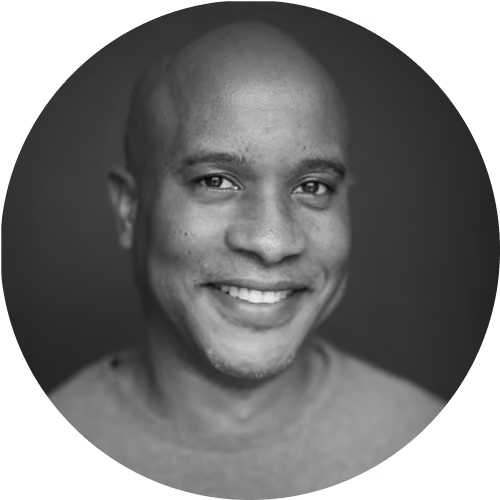
So my name is Yemi Rose, and I'm an entrepreneur, the founder of a company called OfColor, which we exited in 2024. And I've been working with the folks at Greater for a very long time.
What was going on in the business back then, and what made you realize you needed help before you reached out to us?
When Greater stepped in to really help us a great deal, we were struggling to find that real brand voice, not only brand voice, but the connection between all the different elements to look and feel that communicated our purpose. The Greater team came in and they offered to review a lot of different potential brand attributes that really helped to streamline our story and how we communicated. And they were also great in terms of, they'd worked with a lot of startups in the past, and being able to not only keep it fast and on budget for us, but also give us good advice on how we could utilize the assets.
What had you already tried before Greater, and why didn't it hold?
I had spoken to a lot of individual designers who may have been really, really good at what they did, in that they were able to produce a great logo, or maybe there was another aspect they were really good at, but Greater was the first team that I came across that were able to really put all of those different elements together. And as a founder, it can be sometimes, you know what you want and you'll know when you see it, so there can be a lot of back and forth. Greater was able to split the concepts into really discrete buckets and then show design elements and strategies based on that, before we even took it further. And that was really helpful for me.
Could you talk through what exactly you started working with us and then talk about where things went?
In terms of where we started and where we ended up, we started really simple. We started with just a small brand sprint, where we looked at different ideas and concepts. And then once we were able to take that and run with it, they were able to create our full brand book and to consult with us going years into the future, ultimately working on things like all of our visual elements, presentations, the way we crafted and designed articles and content, and the way that we built our entire platform. They were able to really help design all the UX elements and really streamline the platform for us to optimize engagement in the way that we required.
Thinking about early engagements and how you used to work with other outside partners, did you have any hesitations about bringing in someone from the outside?
I really didn't have any hesitation about bringing in someone from the outside. One of the great and humbling things about being a founder is that you have to strip yourself of ego, and you have to embrace expertise. I know what I know, I know what I don't know, and I really appreciate when folks come in that can teach me. You kind of have to leave your ego at the door. And so that involved opening up to different people. Now, there's ultimately a trust factor there, you're creating something, you have your baby that you're putting out into the world, and so you have to trust the folks you're working with. And I think one of the things that resonated with me with the Greater team initially was the ethos around really working with founders who were trying to do social good in the world. And knowing that we were on the same page there was a real comfort, and it enabled me to fully put my trust in their team.
Part 2: Working Together
Tell us about the first project. What was the main problem we set out to solve?
It was really blue sky. I knew what I wanted our company to accomplish, I knew what our mission was, I knew how we wanted to deliver these services. I just didn't know how to create a brand, logo, or imagery that would help encapsulate it all. And it's a fairly common branding exercise at different studios, but the Greater process was great for me as a founder with a discrete budget, in that it was a two week sprint. The price was priced for follow-up engagements if you liked what you saw initially. And so that was really, really helpful. The team came in and they helped us create a brand logo that really did everything we wanted. It showed strength, resilience, it captured the struggle of the users we were trying to really articulate, and it captured what we wanted, which was this kind of motion towards growth. So we were really, really happy with that. And then that turned into different color schemes and brand elements that we would go on to ultimately include across our entire platform, including our UX.
What was it like working with us in those early days? How did it actually fit?
Very, very early on in terms of working with Greater, it was really heartening to see a team that worked at the pace I wanted to work at. When you're a founder, you are in a hurry. You're always in a hurry, because time is literally money, it's runway. You want to work with a team that is fast but also good, because very often you get fast, but it really doesn't end up being fast if you have to go back and make a ton of changes and corrections. But the Greater studio team worked at the pace of startups. They were used to sprints, and that sprint strategy, and working with engineers. And so they were able to deliver really, really quickly, so we could either win fast or fail fast and move on. That was very appreciated.
Was there a specific moment when it clicked, when you realized the partnership was really working?
Especially because we started in a virtual setting, it's always when you actually get together in person with both teams, and you see how easily and how comfortable folks are together. That really makes a big difference, because especially when you're in the trenches and going fast, you have to kind of like the people you're working with, because it does get stressful. And to see those kinds of personalities mesh was really heartening, and I knew that I'd made the right choice.
Where did the work end up going beyond what you first expected?
Look, I initially thought we were bringing in a design studio. What ended up happening was us really finding a partner that served almost as a consultant, really understanding our business goals and our growth goals, and then working backwards from that, recognizing that yes, we need engagement from users, but we ultimately also need buyers to understand where we are, in order to bring those groups together. And so really having a team that understood the financing world, understood startup growth, was invaluable, because I ended up learning quite a bit myself.
Was there ever a point where we pushed back or suggested something you weren't sure about, and how did that turn out?
Listen, I love pushback. I think feedback is a gift. I think part of being successful as a founder, part of being successful at anything, is really trying to remove ego from the situation. I think sometimes founders can fall in love with what they're building, and it's really good to have folks push back, and push back smartly. I think very often people can be in a position where it's easy to criticize, it's easy to pick things apart, but to have a team that does constructive criticism, that can say, okay, this may not work and here is why, and really lay out your options for you, and lay out the possible consequences, good or bad, for those actions, I think that's really, really helpful. And the team has always been extremely professional, and I look forward to them pushing back, because it helps me refine what I'm doing, and I'm a strong believer that iron sharpens iron.
What surprised you most about our process?
Honestly, was the speed at which I got things done. It was both comprehensive and fast. And I think that was really a result of the Greater team meeting us where we were in the digital space, leveraging things like online polling to get consensus, not wasting time. And very often you get into this flow where you're just having meetings for meetings' sake, but they always came and facilitated really quick, fast, insightful meetings where not a minute was wasted, and then they were able to always come back from these meetings with things that helped move the ball forward for us.
Part 3: The System and the Handoff
What's something your team does now that it simply didn't do before?
I think the biggest thing for us was really starting to adopt a design thinking approach, looking at the impact. Things like just proper UX design had an increasing effect on engagement, for example, and starting to really absorb those lessons and apply them in a lot of different areas of our lives. So design thinking, and that whole paradigm, was really a big game changer for us. And it was really something that was precipitated by the Greater team.
Is there a system we built that you used to have to think through manually, or something you really had to be in charge of?
We had produced a number of videos that were really lengthy. Producing the videos took a lot of time, content in general was a real big cost for us in terms of the time spent. And the Greater team really helped to streamline that process, putting guardrails around how long we were going to have videos run, how long scripts were going to be, just a structure of content in terms of getting us to the meat faster. And they really streamlined a storyboarding process for us, and that enabled us to produce a lot more content, but also a lot more effective content.
Part 4: Outcomes and Results
What metrics were you watching, and how did they move?
We were paying attention to several metrics, especially when it comes to the usage of our platform. The big one for us was engagement. So we were looking at how long people spend on the platform, where they go, what path they took to arrive at a payoff for them. And we initially were having, for example, people watch videos and then maybe stop a third of the way through and not really get to the payoff. And especially as we streamlined the content process and the video creation process with Greater, those numbers all improved. Time on the site improved, video watching time improved, and next best action improved. So we had folks not only complete an action, but know what they wanted to do next and make plans for it. And that really is invaluable, especially when you're working with HR functions, where you want to show that employees are using what they're providing.
How did our collaboration pay off?
When we started with Greater, we hadn't raised a dollar yet in terms of institutional capital. Greater was the team that helped put together our first demo that got us into the Techstars program. So every pitch deck that we put in front of an investor had Greater's fingerprints all over it. They were really instrumental in helping us put our best foot forward as a polished entity, one that you could put alongside any of the other, much larger and better-funded companies that investors were also speaking to.
Part 5: Partnership and What's Next
What is the biggest value you gained from working with Greater?
So when you're in this startup world, it's very, very important that the quality of your work, the quality of your design systems, lines up with what institutional investors are used to seeing, what buyers are used to seeing, and that requires a level of polish that really communicates that a lot of thought went into every element. I think about my engagement with Apple products, it starts when I'm opening the package, and my thinking is, if they put this much time into just the package, imagine what the actual product is going to be like. I think Greater helped us round out our offering and be consistent in all the elements throughout, and that showed a level of professionalism that investors, a lot of whom realistically pattern match, were used to and expected, so we came in on the same level as everyone else instead of coming in at a deficit.
What's different about Greater compared to other agencies you've worked with?
The thing that stood out to me the most, is quality at speed. Really, really fast and high quality. They operated at the sprint level that our team was operating at, where we just turned over two week sprints continually, and that requires planning, that requires all these different elements, but they were able to, we call them ninjas, because they were able to just come in the dark and fix things.
What would you tell a peer who's on the fence about working with Greater?
Folks do come to me for advice every now and again, and I always tell them, connect with the Greater team. You won't regret it. You'll get a real, unbiased assessment of where you are, and they will work with you to help map out where you need to be. I've spoken to a lot of different studios, and I always come back to Greater, because even if it's not what you want to hear, they're going to tell you, and you'll ultimately come around to their position.
Part 6: The Close
If you had to sum up our partnership in a sentence or two, how would you describe the relationship?
I would look at it as just really ego-free collaboration, where everyone wants the same things and you're continually learning from each other.
If you had to describe Greater in a single word or phrase, what would it be?
Ninjas. They're just ninjas in the night.
Is there anything we should have asked but didn't, that you think would be a good note to share?
So to me, a big differentiator with Greater, especially at a time now where everything seems really automated, where everyone's using all these tools and things are kind of regressing towards the mean, and what that means is it's more difficult to get really interesting, breakthrough innovations in design or in the user experience, I think the Greater team brings a level of real humanity and a personal touch to almost everything they do, that engenders this kind of thinking that allows you to really make breakthroughs.
Want to work with us?
Great work starts with a conversation. We help purpose-driven teams launch faster, look sharper, and own their category. Tell us what you're building.


.svg)