research
Article
How to get AI to share your website
Key takeaways
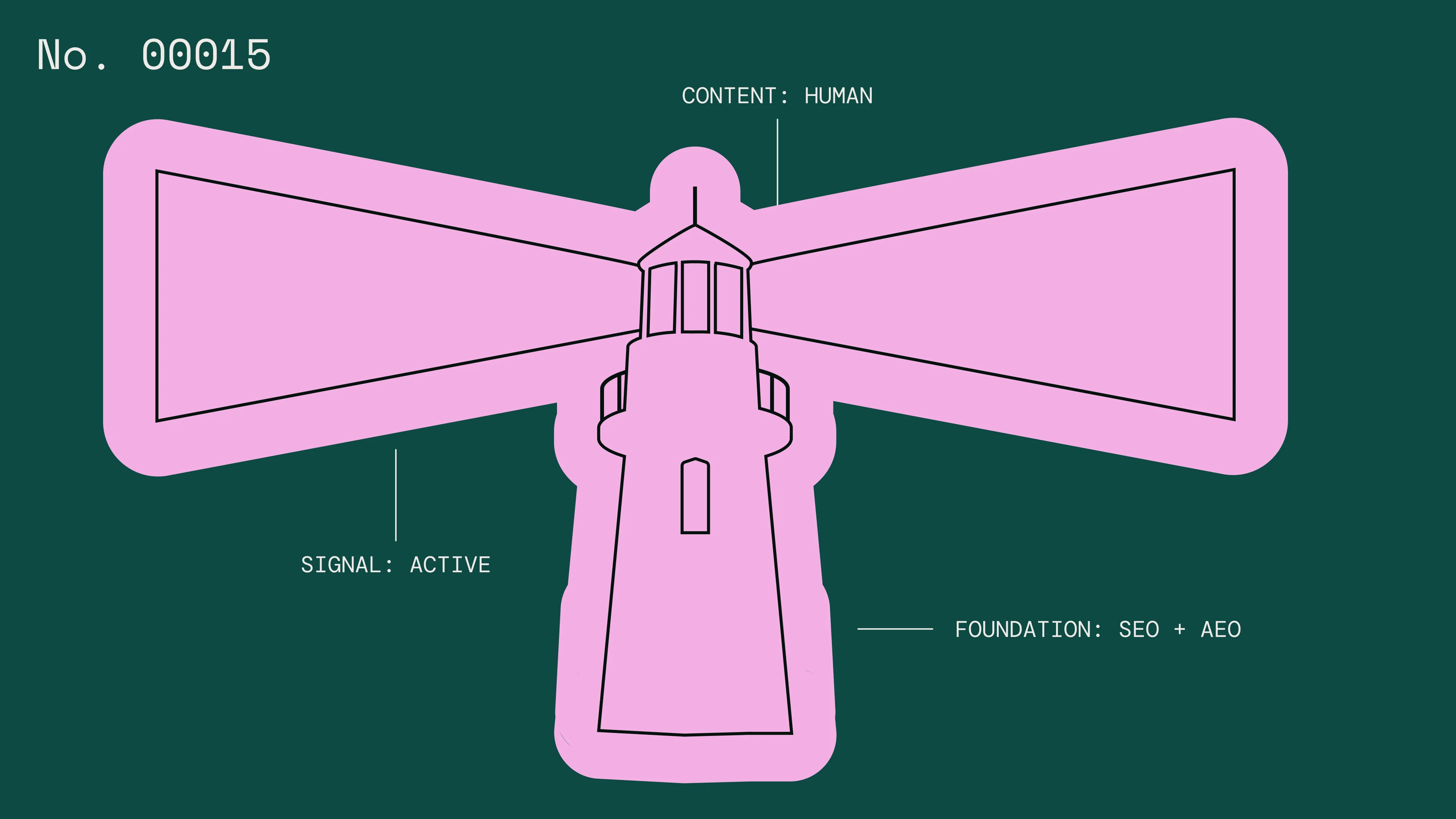
- Prioritize human value: AI models reward authoritative, clear content written for people over content stuffed with keywords for machines.
- Shift to conversational queries: Optimize for longer, natural language questions (averaging 23 words) rather than short, traditional search keywords.
- Technical foundations matter: Use schema markup, fix broken links, and ensure your site is not blocking AI crawlers in robots.txt.
- Make media readable: AI cannot "see" images or "watch" videos; provide descriptive alt text and full transcripts to ensure this content is indexed.
- Consistency is key: A strong, opinionated brand presence across the web (PR, social, podcasts) builds the credibility AI systems look for.
Three terms you need to know
These three come up constantly, often interchangeably, which creates confusion:
SEO (Search Engine Optimization) is the practice of making your content show up in traditional search results like Google. The goal is to rank on the first page when someone searches a keyword relevant to your business. SEO has been around for decades, and its fundamentals (good content, clean site structure, relevant links, etc.) still matter.
AEO (Answer Engine Optimization) is the evolution of that same idea applied to AI platforms. Instead of optimizing to appear in a list of links, you are optimizing to appear as part of the answer when someone asks ChatGPT, Claude, Gemini, Perplexity, or Microsoft Copilot a question you want to be known for. The activity is the same: get your content in front of the right people at the right moment.
GEO (Generative Engine Optimization) refers to the same concept, just with a broader scope. Where AEO focuses specifically on search-oriented AI tools, GEO encompasses optimization across all large language models and generative AI systems, including those embedded in applications and products that have nothing to do with search. According to Conductor's research, both practices share similar optimization principles: structured content, authoritative sources, semantic clarity, and technical excellence.
For practical purposes, AEO and GEO point to the same work. The industry has not settled on a single term. We use AEO because it centers the action rather than the underlying technology. You are optimizing to be the answer, not to game a particular system.
Overview
A client came to us not long ago with a site that looked genuinely good. Clean layout, strong brand presence, sharp copy. Their previous agency had done a good job, but there was just one problem: nobody could find it. Not through search or ChatGPT.
The site existed, technically. But to the systems that increasingly decide what gets seen and what gets skipped, it might as well not have existed at all. This isn't an isolated story
The instinct when you hear it is usually to reach for a technical fix: add schema, tweak metadata, optimize for crawlers. That instinct isn't wrong, but it's incomplete, because the brands getting found right now aren't the ones that optimized hardest for machines. They're the ones who wrote clearly for people, then made sure machines could read what they wrote.
That distinction matters more than most teams realize, and here's how to close the gap.
Design for humans, be found by machines.
The principle that should govern every decision on your site is: build for the person reading it, then make it easy for the systems delivering it.
That sounds obvious, but it rarely gets applied. The pressure to "optimize for AI" has produced a new breed of sites that are technically structured and soulless to read. Chunked content, bulleted everything, no narrative thread, no voice. The copy is written to match a keyword, not to answer an actual question someone has at 2 pm when they are trying to make a case to their CFO.
AI systems do not actually want that, and neither do humans. The websites getting cited most in AI-generated answers are the ones with clear, authoritative, genuine content, not the ones that tried to game the system with structure and sacrificed everything else to do it. Google has said publicly: “Write for humans.” The LLMs are looking for the same thing Google has always valued: quality content that earns trust.
The point is not that technical optimization doesn't matter. It does, and we will get to all of it. The point is that it only works when there is something worth surfacing underneath it. Great structure on thin content is still thin content. A well-tagged page with nothing to say is still a page with nothing to say.
So, what are you supposed to do? Start with the substance. Make it genuinely useful to the person reading it. Then, give the machines every reason to deliver it.
What changed (and why it matters now)
For most of the internet's history, search meant Google. You typed a few keywords, scanned ten blue links, and clicked. Brands optimized for that. They picked keywords, built backlinks, wrote meta descriptions, and hoped for a spot on the first page.
That model is not dead, but it stopped being the whole picture a while ago.
People are asking questions now, not typing keywords. They are having full conversations with AI tools instead of scrolling through results pages. Average Google queries run about 3.4 words. Average queries to large language models run around 23 words and are growing. The behavior is genuinely different, and the systems powering those answers are built on completely different logic.
ChatGPT reached 800 million weekly active users by October 2025, according to OpenAI CEO Sam Altman. One in ten U.S. internet users now turns to generative AI first when searching online. Google AI Overviews peaked at nearly 25% of all searches in mid-2025 before settling back to around 16% by late in the year, and are still expanding into commercial and navigational queries. This is how buyers research, compare, and decide today.
The brands showing up in those AI answers are not necessarily the biggest or the best-funded. They are the ones who understood the new rules early.
The mistake most teams are making
The most common error we see is treating this as a binary choice. Teams either dismiss AEO entirely ("we do SEO, that covers it") or they pivot hard ("SEO is dead, we're doing AEO now") and abandon what was already working.
Both are wrong.
Good SEO is the foundation of good AEO. The core principles that helped you rank on Google, authoritative content, clean site structure, relevant internal linking, and zero broken links, are the same signals AI systems look for. 37.2% of marketing teams are actively optimizing for AI search visibility, while another 30.8% have not yet implemented strategies but are exploring them. The teams treating this as a fresh start from scratch are wasting time, and the teams doing nothing are falling behind.
The subtler mistake, and the one that matters more to us as designers, is building for machines at the expense of humans. Some teams hear "optimize for AI" and immediately want to strip away everything that makes a site interesting to the person actually visiting it. They chunk content into ugly blocks, bury visual hierarchy under technical structure, and create sites that no human wants to spend time on.
AI systems are not asking for that. They want content to be well-organized, clearly written, and genuinely useful.
Part one: Write and design for the person
Everything in this section starts with the same question: Is this useful and clear to the actual human reading it? If the answer is yes, you are already most of the way there for AI systems too. If the answer is no, no amount of technical optimization will fix it.
Answer real questions, not imagined keywords
The shift from keyword search to conversational AI queries is significant for how you write. Someone typing into Google might search "Webflow agency NYC." That same person asking ChatGPT is more likely to write "what should I look for when hiring a Webflow agency for a brand redesign, and are there good ones in New York?" Those are different documents.
Write for the second version of that person. Write the way you would explain your work to a smart client who does not know your industry jargon. Anticipate the follow-up questions. Give a real answer, not a keyword-optimized one. The LLM reading your content is looking for substance that matches the depth of the question being asked, and questions are getting longer and more specific every month.
Put the most important thing first
A common web design habit is to build up to the point. Long introductions, atmospheric photography, and a brand story before the offer. There is a place for all of that, but on pages meant to convert or inform, the most important idea should appear early.
This is good writing advice, but also good AEO advice. AI systems make quick decisions about whether a page is worth reading further, based on what they encounter at the top. If the first screenful is vague or brand-forward without being specific, you have given the machine less reason to dig in. Answer the core question: what is this, who is it for, and why does it matter, before you do anything else.
Use headings the way a good writer uses them
H1, H2, H3 tags are not just structural scaffolding. They tell a story about how your content is organized, what matters most, and how the ideas relate to each other. If a developer is building pages where text just looks like a heading visually but is not actually coded as one, you are making every reader, human and machine, do extra work to figure out what matters on the page.
One H1 per page and logical H2s and H3s that reflect real hierarchy. Not because it is a rule, but because a well-organized page is easier to read, easier to trust, and easier for AI systems to extract meaning from.
Build a real FAQ section. And mean it.
This is the one we have to push frequently on, because resistance is common. Clients say they do not need FAQs, or that they will add them later, or that the site already explains everything.
FAQs are not just a technical tactic. We suggest thinking about them as a service to the reader. They reflect genuine questions your customers actually ask. Done well, they make your site more useful to someone who landed on it with a specific concern and wants a direct answer. Done poorly, generic, vague, written to hit keywords, they help no one.
Write them for the person with the actual question. Then they will also work for the AI system that is trying to match your content to that same question. Webflow ran their own test on this: they added FAQs and schema to six product pages and, within two weeks, those six pages accounted for 57% of all incremental LLM citations Webflow received across its entire site. Six pages resulted in more than half of all new AI citations.
Play a long game with brand consistency
The last principle here is the one that feels least tactical but compounds the hardest. LLMs build their understanding of a brand from everything that exists about it across the entire web. Your site is the most controllable source, but it is not the only one.
Guest posts, podcast appearances, press coverage, social content, conference talks, etc. All of it feeds into how AI systems understand who you are, what you do, and whether you are a credible source worth citing. A brand with a strong point of view, expressed consistently across many contexts, builds more AI visibility than one with a technically perfect website and nothing else.
Brand is having a quiet renaissance, partly for this reason. Consistent, opinionated, well-distributed content is exactly what LLMs reward, and it is also what builds real relationships with real people.
Part two: Make sure machines can read what you built
Once your content is worth surfacing, give the technical layer every reason to surface it. None of this replaces good writing and design; it amplifies it.
How AI systems actually decide what to cite
Not all AI tools work the same way, and the difference matters for how you prioritize.
Some, like ChatGPT in its base form, generate answers from patterns learned during training on a large body of indexed web content. Your site needs to have existed, been crawled, and been deemed credible before that training cutoff for it to factor in at all. Getting cited in those answers is a slower, longer game built entirely on content quality and domain authority over time.
Others, like Perplexity and ChatGPT with search enabled, work differently. They actively crawl the web in real time, closer to how a search engine operates, then use what they find to generate and ground their answers. For these tools, your current content matters right now, and technical factors like crawler access, page speed, and structured data have immediate weight.
Google AI Overviews sit somewhere in between: drawing on Google's existing index and ranking signals, then layering generative summarization on top. Strong traditional SEO is your foundation here.
Knowing which system you are trying to reach helps you sequence the work. If your priority is Perplexity or AI-assisted search, fix crawler access and schema first. If you are playing the longer game of getting trained into model knowledge, the content investment compounds more slowly but more durably.
Start with what is broken
Before adding anything, audit what is broken. Broken internal links are a quiet killer. An LLM or search engine evaluating your site is constantly making a calculation: how expensive is it to crawl this site versus how good is it? Broken links make that calculation go the wrong way, so fix them first.
Then check whether you are accidentally blocking crawlers. According to Conductor's data, ChatGPT accounts for 87.4% of all AI referral traffic across industries. If your robots.txt file is blocking AI crawlers, or if restrictions that made sense for some other purpose are now preventing LLMs from seeing your content, you are cutting off your own visibility. Unless you are specifically protecting proprietary content, open the door.
Add schema markup
Schema or JSON-LD file is structured metadata that tells machines exactly what kind of content is on each page. An events page, a product page, an FAQ, a company about page, etc. Humans never see it, but machines rely on it heavily.
Adding schema, especially to FAQ sections and key product or service pages, is one of the highest-return technical moves you can make right now. Webflow can auto-generate a lot of this on static pages, which is part of why it is a strong platform for AEO-minded brands. But on any platform, schema should be a standard part of every site build and redesign, not an afterthought.
Get your metadata working for images and video
Every image on your site should have alt text that accurately describes what is in it. Skip it, and you hand the machine a blank. An LLM cannot see your hero image. It reads the alt text. If that text says "img_4729.jpg" or nothing at all, you have wasted that asset.
The same logic applies to video. AI systems do not watch videos; they read the transcript. If your video content has a transcript, either visible on the page or embedded in the metadata, it feeds directly into your AEO. If there is no transcript, the video is invisible to the machine. Webflow can help auto-generate both, but they need to be part of the workflow on any platform.
One more thing on images: if words are embedded inside a graphic, a pull quote, a stat callout, or a nav element built as an image file, those words do not exist to a search engine or LLM. The machine reads the alt text and moves on. Text that lives as an image is text that cannot be found.
Add a table of contents to long content
For blog posts and long-form pages, a table of contents in the sidebar or near the top is an easy structural signal that helps LLMs navigate what you have written. Good for human readers too. One of those small details that costs almost nothing and compounds quietly.
Take page speed seriously
Not new advice, but consistently ignored, especially by design-forward teams who believe a beautiful experience justifies slower loading.
Milliseconds of load time have a measurable impact on whether visitors stay on a page or leave before it finishes loading. They also factor into how search engines and AI systems evaluate your site's quality. Unoptimized images and video assets are the most common culprits. Compress your assets, lazy load video, and use formats like WebP for images. Compressing assets does not compromise experience.
What to do next
You do not need to rebuild your site; you need to look at it honestly, through both lenses at once.
Is the content genuinely useful to the person reading it? Is it clear, specific, and worth returning to? If not, start there. No technical optimization will make thin content perform well for long.
Then check the technical layer. Search your own brand in ChatGPT, Claude, and Perplexity. See what comes back. Are you being cited? If you are, is the information accurate? If you are not, that tells you something. Webflow offers a free diagnostic tool, and comparable audits exist for other platforms: webflow.com/aeo. It runs a diagnostic across your site against a maturity rubric and gives you a real starting point.
From there, the priorities are: fix broken links and open crawler access, add schema, add or improve FAQs, clean up heading structure, add alt text to images, add transcripts to video, and compress your assets.
This is the foundational work that makes everything else you put on your site actually reach the people it is meant for. At Greater, this is how we have transitioned the way we build. Every Webflow project we take on, from brand strategy through launch, treats AEO as part of the design process, not a checklist item at the end. If your site is not showing up the way it should, we can help you understand why and fix it.
FAQs
Is AEO the same thing as SEO? They share the same foundations: clear content, good technical structure, credible sourcing. AEO is the evolution of SEO applied specifically to AI platforms and answer engines like ChatGPT, Perplexity, and Google's AI Overviews. The best approach treats them as a unified strategy, not competing priorities.
Does my site need to be on Webflow to benefit from AEO improvements? No. The principles of AEO apply regardless of platform. That said, Webflow automates a significant amount of the technical work, including schema generation, alt text suggestions, SEO metadata, and sitemap creation. For teams with limited technical resources, it removes a lot of friction.
How long does it take to see results from AEO changes? There is no fixed timeline, and anyone who gives you one is guessing. Webflow added FAQs and schema to six pages and saw measurable citation results within two weeks. Other changes compound more slowly. Technical fixes tend to show results faster; content-based improvements take longer but build more durable visibility.
Should I stop investing in SEO to focus on AEO? No. SEO is not going away, and strong SEO makes AEO easier. The two strategies reinforce each other.
What is schema markup, and do I actually need it? Schema is structured metadata that tells machines what kind of page they are looking at: a product page, an FAQ, an event, a company profile. You need it. One of the clearest signals you can send to an LLM that your content matches a particular type of question. Skip schema, and you are asking AI systems to guess at what you do.
How do I know if AI systems are currently citing my brand? The simplest approach is to manually ask. Open ChatGPT, Perplexity, and Claude and search for your brand name, your services, and the questions your customers typically ask. See what comes back. For more systematic tracking, tools like Semrush and Conductor now include AI visibility monitoring that tracks citation frequency, sentiment, and share of voice across platforms. Webflow's free AEO tool is also a fast starting point.
I already have a beautiful site. Why do I need to worry about this? Because a site that no one can find is not doing its job. Visual quality and search visibility are different problems with different solutions. A lot of visually exceptional sites are nearly invisible to AI systems because the underlying structure was built purely for human aesthetics. You do not have to choose between the two, but you do have to address both.
Does video content help with AEO? Yes, with a caveat. AI systems do not watch videos. They read the transcript. If your video has a transcript, either published on the page or in the metadata, it feeds directly into your AEO. YouTube specifically gets more attention from LLMs than most other platforms. If you have explainer video content sitting on other channels, reposting it to YouTube with proper transcripts is a reasonable experiment worth running.
Does AEO work differently for B2B versus B2C brands? The principles are the same, but the queries differ significantly. B2B buyers tend to ask longer, more specific questions ("what should I look for in a UX agency for a SaaS product redesign") while B2C leans shorter and more comparative. B2B brands often have a smaller, more defined question set to own, which makes FAQ and schema investment especially high-return.
What if an AI system is citing my brand but getting the information wrong? This happens, and it matters. The fix is usually a content problem, not a technical one. If the AI is pulling inaccurate information, it means your own site is not the clearest or most authoritative source on that topic. Write a definitive, clearly sourced page that directly addresses whatever is being misrepresented. That gives the model a better source to pull from.
How does internal linking affect AEO? More than most teams expect. When your content is well-connected internally, it helps AI systems understand how your ideas relate to each other, which builds topical authority on a subject. A cluster of well-linked pages on a single topic signals expertise more clearly than an isolated page that covers the same ground.
Does social media presence factor into AI visibility? Indirectly. AI systems do not crawl social platforms the way search engines do, but consistent brand presence across LinkedIn, YouTube, and industry publications contributes to how your brand is understood at a broader level. YouTube is the exception worth calling out specifically: LLMs give it more weight than most other platforms, and transcribed video content there feeds directly into AI answers.
How often should I update existing content for AEO? Freshness signals matter, but wholesale rewrites usually are not the answer. Adding a "last updated" date, expanding thin sections, incorporating new examples, and keeping FAQ responses current tends to outperform starting from scratch. The goal is to give AI systems a reason to keep returning to your content, not just to index it once.
Does paid search advertising affect AEO? No. Paid ads do not influence organic AI citation or search ranking. The two systems are entirely separate. AEO is earned through content quality and technical foundation, not ad spend.

table of contents
Want more like this?
Subscribe to stay in the loop.
More content
Learn about other things on our mind








.svg)