Marketing automation with AI agents
Agents that ship inside the rules you set.
Most teams have run the experiments by now. The demos were impressive and almost none of it made it into the actual workflow, because nobody could answer what happens when the agent gets it wrong. That's a guardrail problem, and guardrails are buildable.




THE PROBLEM
The pilots worked, but nothing went into production.
Nobody could answer what happens when the agent gets it wrong, so none of it shipped.
No deployment
Output that costs more to check than to write
Nobody owns the agents' actions
WHAT WE DO
Agents ship, you decide.
We build the layer most agent work skips: the standards, validators, and permissions that make output safe to ship without you checking every line.
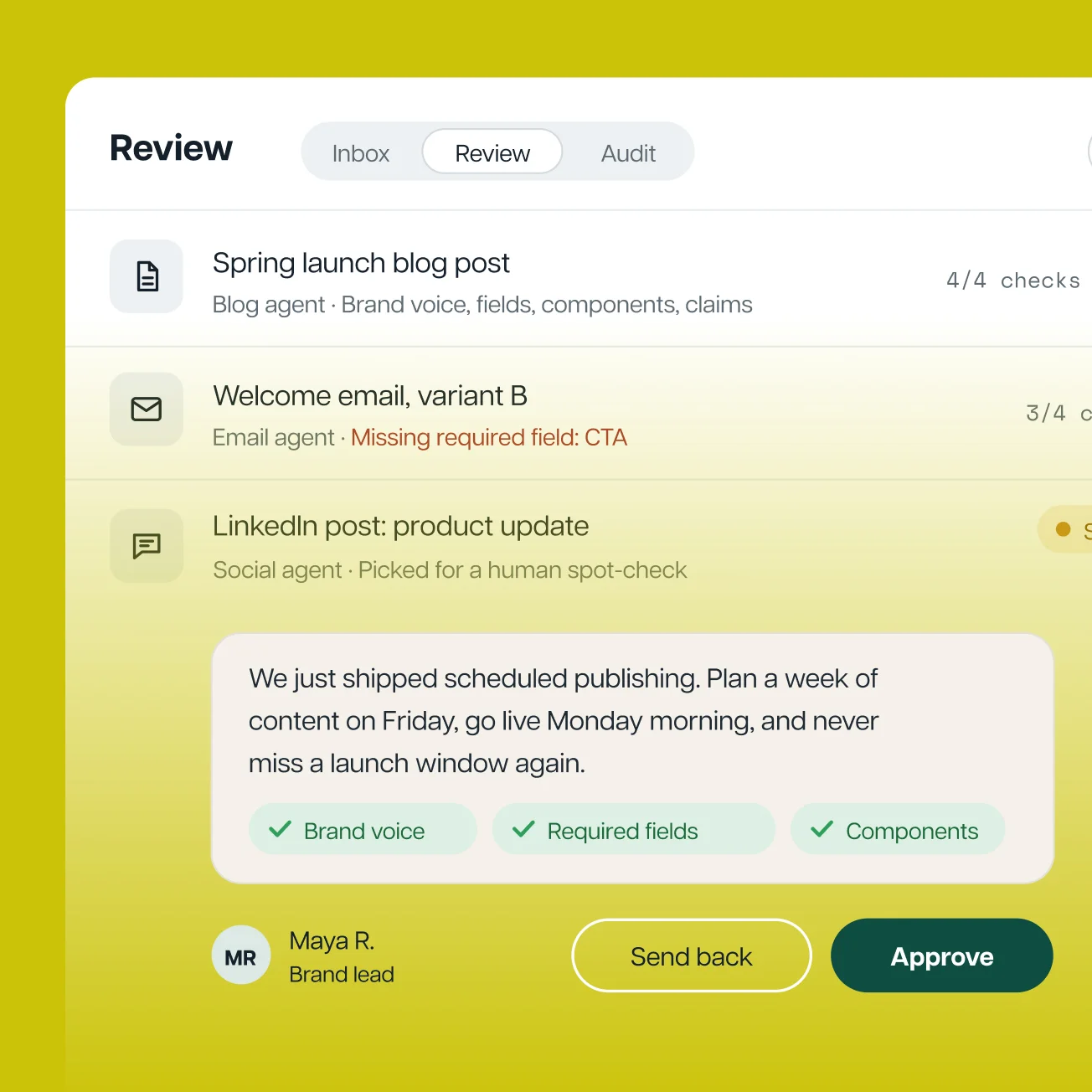
A standard to sign off against
Reviewing becomes sampling
One owner, one permission model
DELIVERABLES
What you'll walk away with.
The system that turns agents from an impressive demo into production you can trust.
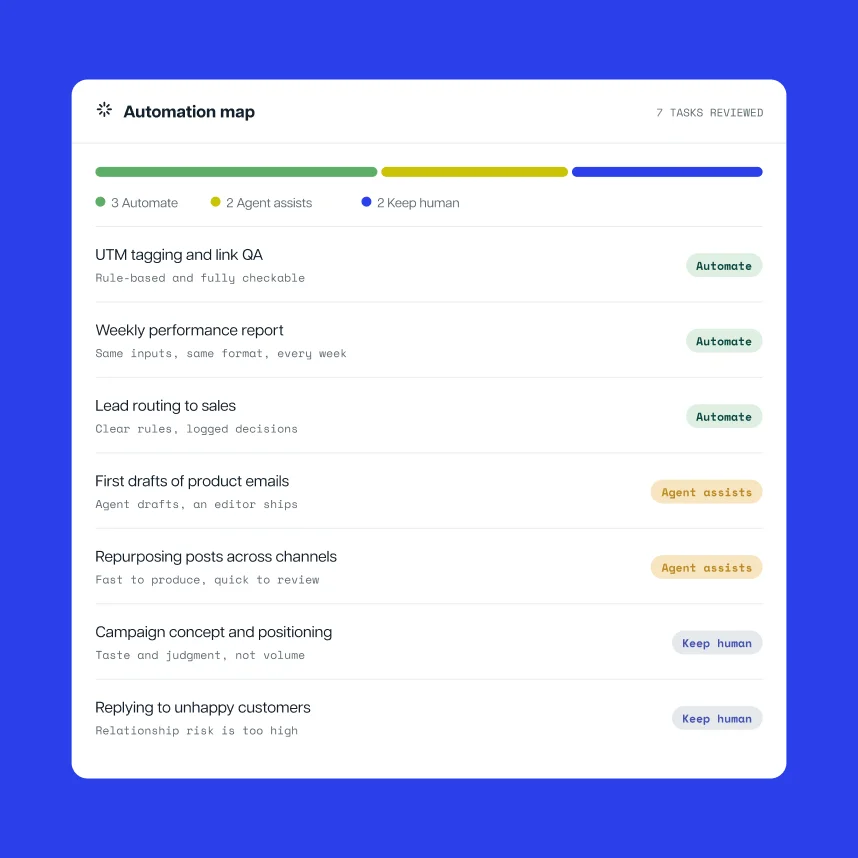
Automation map
Context layer
Scoped working agents
Guardrail configuration
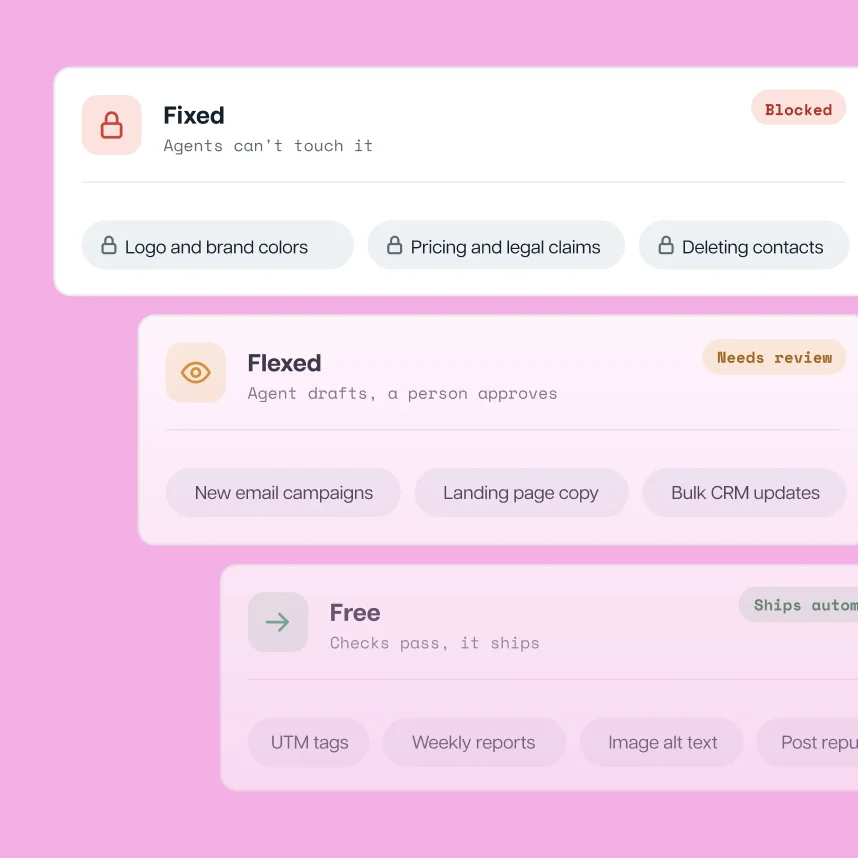
Tested, verifiable output
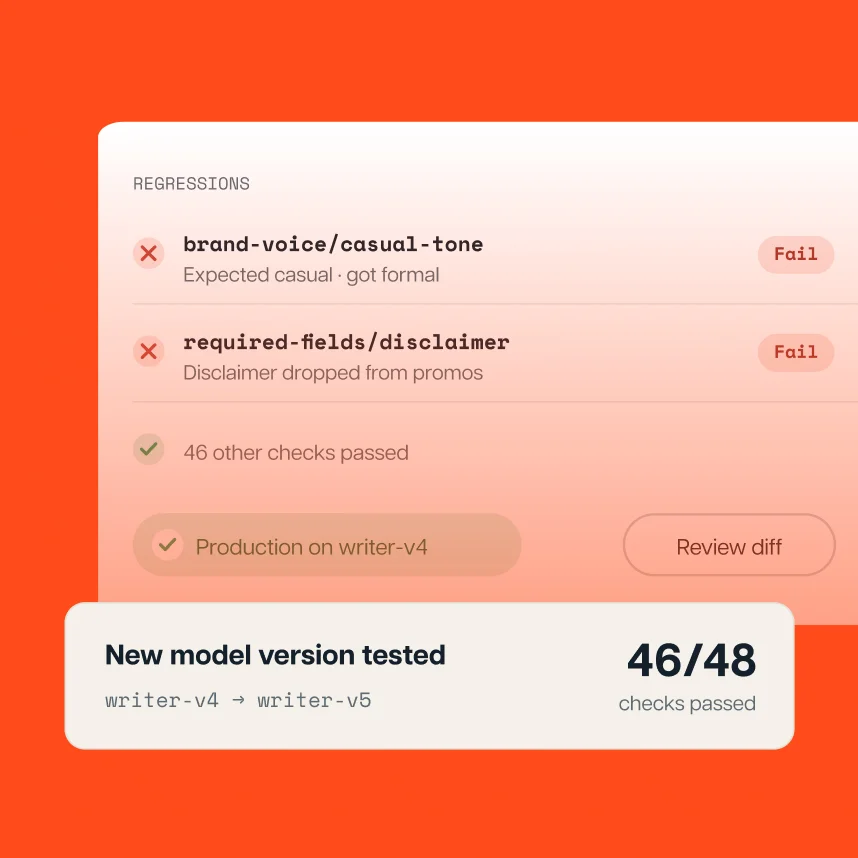
Logging, sampling, and rollback
Our methodology
Keep agents working under your own rules.
We start by being honest about what shouldn’t be automated, then build the governance that makes the rest safe to run.
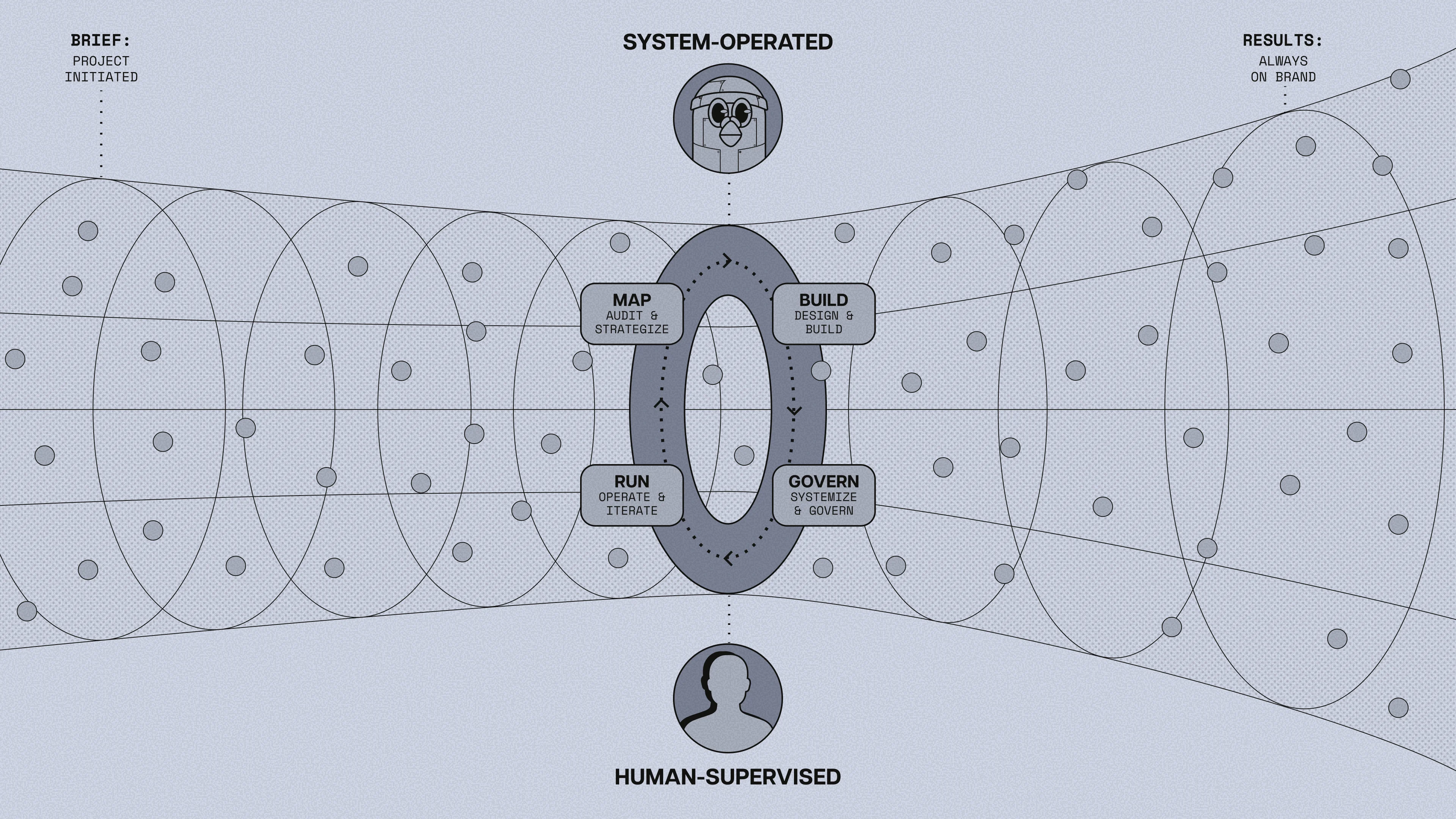

map
Decide what not to automate
We inventory what your team actually does repeatedly, how much judgment each task requires, and what the cost of a wrong answer is. This sets what agents can do unsupervised, draft for review, and what shouldn't be automated.
build
Context first
Context layer first, then constraints, then the agents themselves, then the evaluation set. This stops agents from producing confident nonsense.
run
Supervise, don't deploy
Output sampled, guardrails tuned as volume and risk change, evals re-run when models update, and the autonomy boundary moved deliberately as evidence accumulates. Agents need the same supervision as anything else that publishes on your behalf.
Case Studies
Explore our work
Brand, web, content, and the systems underneath, across industries and stages.



complementary services
Beyond Automations.

MVB


Brand Transformation
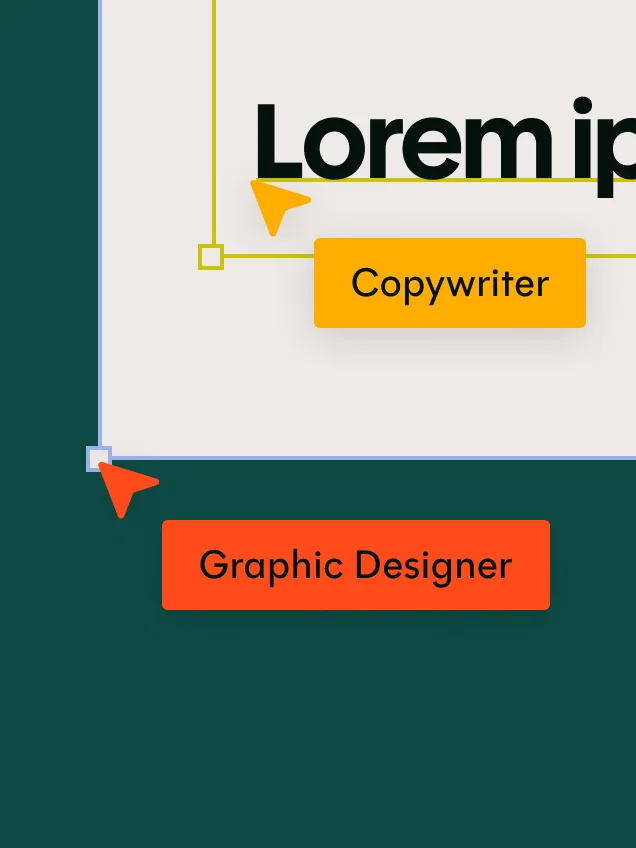
Embedded Brand Team
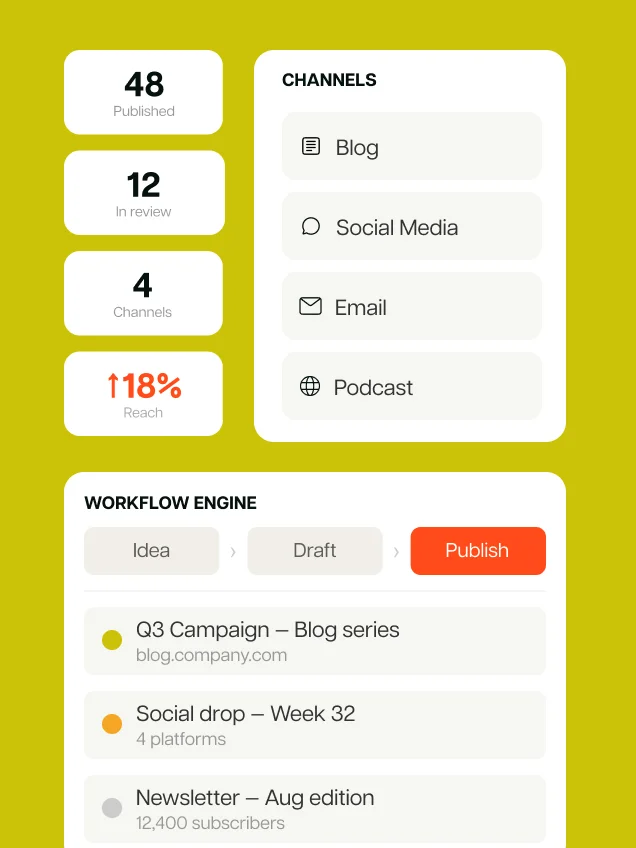
Content OS
Promotional Videos

Embedded Content Team

Site Migration
Component Libraries
Custom Site

MVP

Transformation Sprint

Embedded Product Team


Marketing automation with AI Agents
Let's find out what's actually safe to automate.
Every engagement starts with a conversation. We'll look at what your team repeats, what it costs you, and where the judgment has to stay.
Frequently Asked Questions
Bounded, well-specified, verifiable work. Drafting a page from approved components. Checking copy against a voice rubric and flagging exceptions. Generating metadata at scale. Routing and enriching. Producing a first draft against a defined brief. What they do unreliably is anything requiring judgment about your business, taste, or unstated context — which is why the useful question isn't whether agents are good enough, but which tasks are shaped so that being wrong is cheap and catchable.
Agents act on the context they're given. A skill or instruction file is a structured document that tells an agent how a particular job should be done — scope, standards, worked examples, what to refuse. Context engineering is the broader discipline of getting the right information in front of the agent at the right time: retrieval over your actual brand corpus rather than a pasted summary, machine-readable specifications rather than prose descriptions. It's the difference between an agent that guesses what you'd want and one that knows.
In layers, because any single layer fails. Context so the agent has something correct to work from. Tool restrictions so it can't take actions outside scope. Deterministic validation that blocks objectively wrong output before it publishes. Review gates on anything requiring judgment. Logging and sampling so problems surface. And evals so you can tell whether a change made things better or worse. Anyone offering one mechanism as the answer is selling the prompt layer.
Behavior changes, usually subtly, and usually without notice. This is the most underappreciated risk in production agent work. We build a regression suite of labeled examples so a model or prompt change can be tested rather than discovered in production. It's unglamorous and it's the difference between an agent you can maintain and one you eventually turn off.
For workflow automation, no — that connects to whatever stack you run. For agents operating on the site itself, the platform matters, because what an agent can safely do depends on what permissions and review mechanisms exist. Webflow Enterprise has native agent governance, which makes some of this considerably easier. On other platforms we build more of the scaffolding ourselves.
Anything where a wrong answer is expensive and hard to detect. Anything requiring context that only lives in people's heads. Anything where the review takes as long as the task. And anything you haven't defined well enough to check — if you can't articulate what good output looks like specifically enough to test it, the agent can't hit it and you can't tell whether it did.
Your choice. Some clients take the agents and workflows and operate them, with us auditing and re-running evals periodically. Others prefer we run the supervision. Either way you own the context layer, the guardrail configuration, and the eval set outright — those are your assets, not ours, and they're the durable part.
Scope of the workflows, how much of the context layer already exists, and how consequential the automated work is. The largest variable is whether your brand is already defined precisely enough for an agent to act on. If it isn't, that's the first work, and it's worth doing regardless of what you automate afterward.
Most of that engagement produces a strategy document and a list of tools. We build the thing and stay to supervise it. The harder and less visible half of this work is governance — validators, evals, permission models, rollback — which doesn't demo well and is what determines whether any of it survives contact with production.